Analogous environments across the tropics have similar levels of tree species alpha diversity
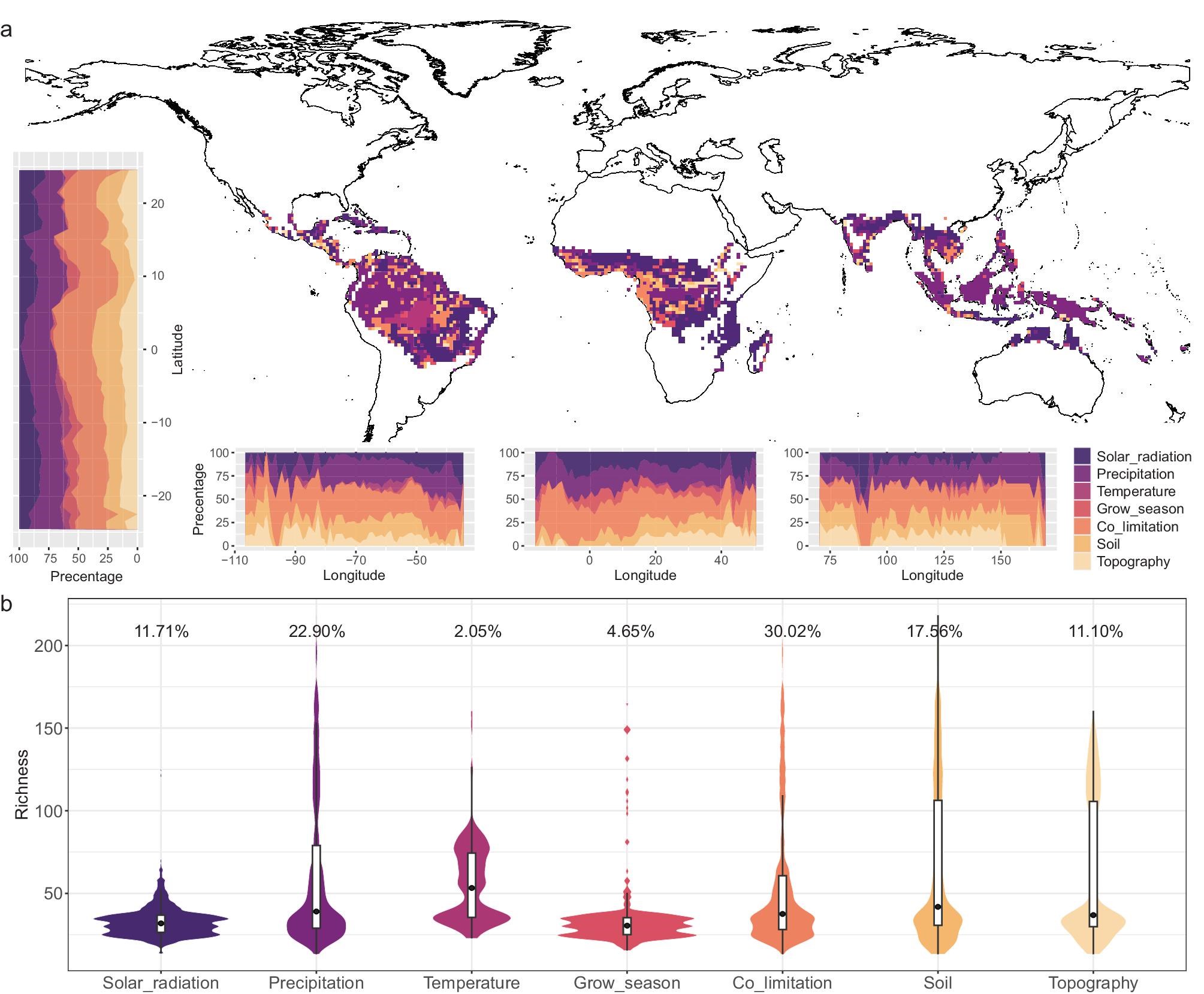 Geographical distribution of predominance of seven categories of environmental variables. Co-limitation refers to areas in which no single factor dominates. (a) Driving factors distribution pattern in pantropical regions, along longitude and latitude. (b) Percentage of main categories driving factors in tropical region.
Abstract
Different regions of the tropics vary in overall tree species diversity, with the tropical Americas exhibiting strikingly higher regional tree species richness than Africa and Southeast Asia. We investigated whether these differences also occur at the local scale and whether the environmental conditions associated with tree species richness are consistent across tropical regions despite highly dissimilar species pools. A spatial random forest model was trained by using a network of 429 1-hectare plots across the tropics, together with 24 environmental variables, to predict plot-level tree α diversity. A combination of climatic, soil and topographical variables explained ∼86% of the variation in richness. Despite differences in regional species pools and the potentially disruptive effects of different geological, climatic and evolutionary histories, the relationship between environmental variables and local-scale tree species richness is closely similar across different continents. Our findings imply a pervasive role of niche-based mechanisms in structuring local tree species richness, regardless of the regional species assemblages. This pantropical convergence in the richness–environment relationship poses a challenge for ecology to explain.